I Thought I Knew Where My Money Went. Then I Checked My Bank Statements.
I expected my online shopping total to be around ₱20,000. It was already more than ₱50,000.
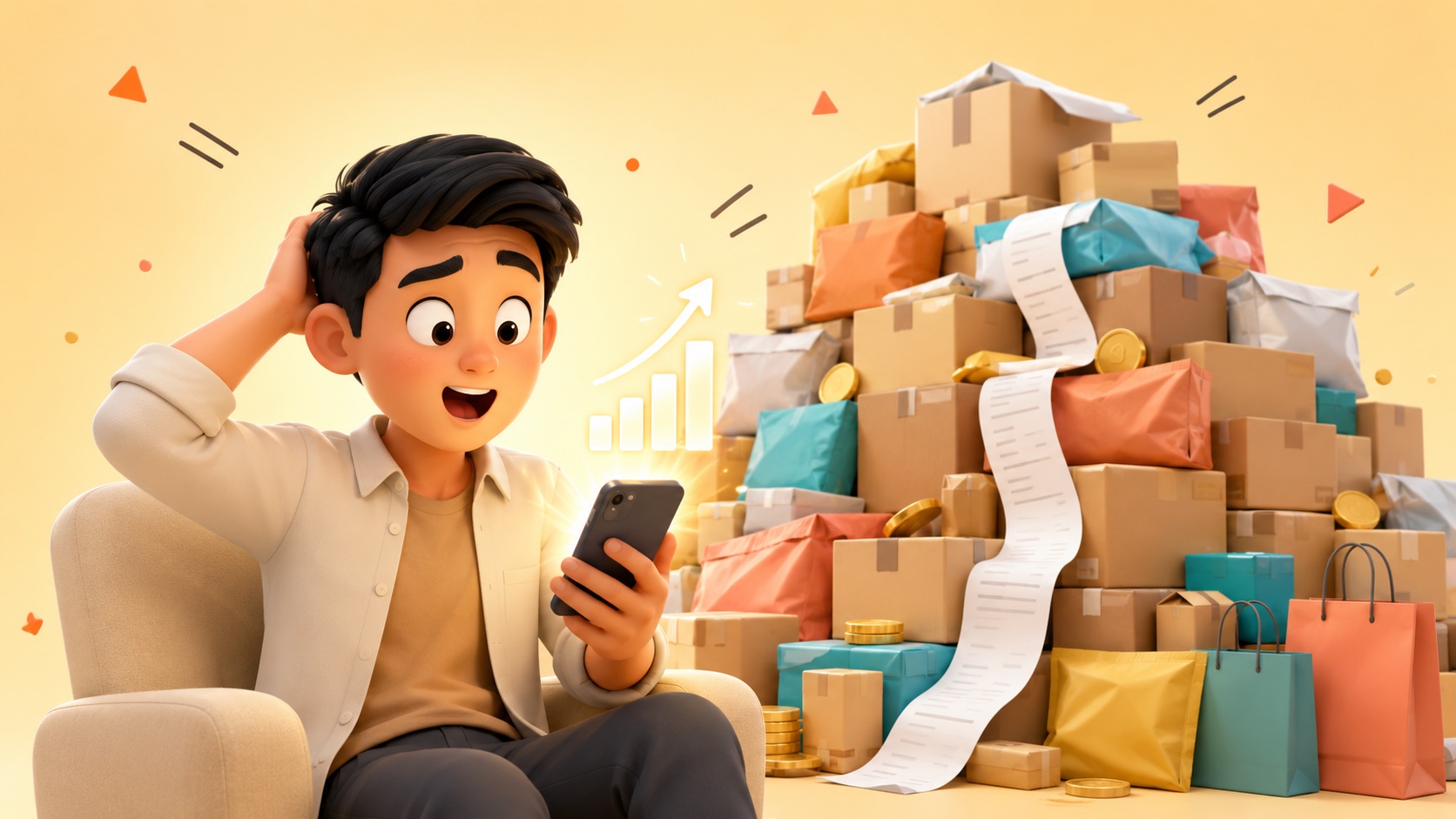
I laughed when I saw the number.
Spending more than ₱50,000 on Lazada and TikTok Shop was not funny. What made me laugh was how far it was from the number in my head.
I thought I had spent somewhere between ₱20,000 and ₱25,000 during the first half of the year.
I was not even close.
I had converted several months of bank statements into a categorized spending report — using Richable's bank statement analyzer — expecting to confirm what I already believed about my finances. I generally avoid large purchases. When something costs a few thousand pesos, I compare options and think carefully before paying.
Then one category stopped me.
My online shopping had already reached more than ₱50,000 — or roughly ₱9,000 a month.
My immediate reaction was to open the transactions.
What did I even buy?
I could remember the larger purchases. One was a smart device for my door that automatically opens and closes the lock through an app. I remembered comparing prices and thinking I had found a good deal.
I also remembered toiletries and personal-care products bought in larger amounts. Those felt intentional because they were things I regularly used.
What I could not remember were all the smaller purchases.
A shirt here.
A travel accessory there.
Something inexpensive that looked useful.
Another item worth trying because it cost less than ₱500.
Each purchase felt too small to matter.
The total told a different story.
Small purchases pass through an easier filter
I do not consider myself a reckless spender.
When something is expensive, I pause. Small purchases receive much less resistance.
It's only ₱299.
I'll wear it anyway.
It looks useful.
It normally costs more than this.
I might need it eventually.
None of those thoughts sounds unreasonable.
An affordable shirt that fits well may be worth buying. A discounted household item can make life more convenient. Some of my higher spending also came from preparing for a trip, so there were understandable reasons behind it.
That is why I did not look at the total and wish I could return everything.
Some purchases were useful. Some introduced me to affordable brands I would buy from again. Others taught me which products were not worth repeating.
The surprise was not that every purchase was bad.
It was that my memory had created a completely different picture of my spending.
We experience ₱299. The statement records the total.
We rarely experience online shopping as one large amount.
We experience individual moments.
A discounted shirt.
A bottle of skincare.
A household item added to the cart.
Something bought before a trip.
A package arriving at the lobby.
Then the transaction disappears from our attention.
The bank statement does something memory does not: it adds every one of those moments together.
That is how dozens of purchases that make sense individually can become a total that is difficult to explain collectively.
My report also showed that this was not one unusually expensive shopping spree. The first few months were higher, partly because of travel preparation. After that, my spending declined to roughly ₱5,000 a month.
That improvement mattered. But even ₱5,000 can disappear into the background when it arrives through many small transactions instead of one memorable purchase.
Our memory records moments.
Our money records totals.
Digital payments change how spending feels
This experience is personal, but the broader pattern is supported by research.
A 2024 meta-analysis covering 71 academic papers found that consumers generally spend more when using cashless payment methods instead of physical cash. Researchers call this the cashless effect.¹ Another study found that increased use of digital payments was associated with higher consumer spending.²
Digital payments are not automatically bad. They make transactions faster, safer and more convenient.
But convenience changes the experience of paying.
When you hand over cash, you see the money leave your hand. Online, the process can take seconds.
Tap the product.
Apply a voucher.
Choose a saved card.
Check out.
The package often feels more real than the payment.
Research on the "pain of paying" suggests that cards and other less visible payment methods can reduce the immediate discomfort of parting with money.³ That makes it easier to focus on the product, the discount and the possibility that the item might be useful.
That described my experience almost perfectly.
I remembered what I bought.
I did not remember the cumulative amount leaving my account.
TikTok Shop surprised me the most
I expected Lazada to dominate my online spending.
That is where I deliberately search for toiletries, household supplies and products I already intend to buy.
TikTok feels different.
I usually open it to watch videos, not to shop.
Yet my TikTok Shop spending was almost as significant as my Lazada spending.
On Lazada, I often begin with a product in mind.
On TikTok, the product often begins with me.
A creator wears a shirt. Another person reviews it. The price is below ₱300. After seeing it several times, the product becomes familiar. Eventually, it feels less like an advertisement and more like something worth trying.
I thought I was managing my finances by avoiding large purchases.
In one sense, I was.
But the statement revealed another route through which money was leaving: frequent purchases small enough to escape serious attention.
A good deal is still spending
Looking back, I noticed how often I described purchases as good deals.
Sometimes that description was accurate. The smart device for my door was cheaper than its usual price. Some shirts were inexpensive and useful. Buying toiletries online may have saved money.
Still, a discount answers only one question:
Is this cheaper than it usually is?
It does not answer another:
Was this already part of how I intended to spend my money?
A product can be worth its price and still push total spending beyond what you would have consciously chosen.
A bank statement does not always expose one terrible decision. Sometimes it exposes dozens of reasonable ones.
What happens after you know?
Seeing the total did not make me want to stop shopping online.
These platforms are useful. They help us compare prices, discover smaller brands and find products that may not be available in a traditional mall.
The more important question came after the surprise:
What do I do now that I know?
Tracking alone does not improve your finances.
A categorized statement can reveal that you spent more than ₱50,000. It cannot decide what the next six months should look like.
That part still belongs to you.
For me, the answer is not a complete shopping ban. I would rather decide what amount feels reasonable and create a simple way to monitor it.
That could mean setting a monthly online-shopping budget, waiting a few days before buying something discovered through TikTok, or reviewing the category every month instead of discovering the total after half a year.
Research suggests that people who develop personal spending-control strategies can meaningfully reduce their spending.⁴ The best system is not necessarily the strictest. It is the one that fits the behavior you are trying to change.
Memory is a poor expense tracker
I built Richable partly because bank statements contain more useful information than most people ever see.
Transactions usually appear as long lists of dates, merchants and amounts. Once they are cleaned, categorized and added together, they tell a different story.
In this case, the story was mine.
I believed I managed my spending partly by avoiding large purchases. The data showed that smaller purchases had created their own category of significant spending.
It did not tell me I was terrible with money.
It told me that I spend differently from how I imagine.
That distinction matters.
Shame makes us avoid the numbers. Curiosity makes us look more closely.
Every few months, estimate how much you think you spent on food delivery, online shopping, subscriptions or transportation. Then compare that estimate with your actual statements.
When the numbers are close, your awareness is probably working.
When they are far apart, you have found a financial blind spot.
I expected my online shopping total to be around ₱20,000.
It was already more than ₱50,000.
The lesson was not that I should never buy another ₱299 shirt.
We experience purchases one at a time, while our money experiences all of them together.
Memory remembers what we bought.
The bank statement remembers what it cost.
References
¹ Schomburgk, L., Belli, A., Hoffmann, A. O. I., & Smith, M. S. (2024). "Less Cash, More Splash? A Meta-Analysis on the Cashless Effect." Journal of Economic Psychology. The researchers reviewed 71 papers and found that consumers generally spend more using cashless payment methods than cash.
² Agarwal, S., Ghosh, P., Li, J., & Ruan, T. (2024). "Digital Payments and Consumption: Evidence from the 2016 Indian Demonetization." The Review of Financial Studies, 37(8), 2550–2585. The study found that increased digital-payment adoption was associated with higher monthly spending.
³ Thomas, M., Desai, K. K., & Seenivasan, S. (2011). "How Credit Card Payments Increase Unhealthy Food Purchases: Visceral Regulation of Vices." Journal of Consumer Research, 38(1), 126–139. The study discusses how credit-card payments can reduce the immediate discomfort associated with paying.
⁴ Peetz, J., Milyavskaya, M., & Klein, R. M. (2021). "Financial Self-Control Strategy Use: Generating Personal Strategies Reduces Spending." Journal of Experimental Social Psychology. The study found that participants prompted to develop personal financial-control strategies spent less than those in the control group.